Open standards instead of dependencies. AI without being tied to the cloud. More control over your own IT strategy.
At our Simplifier Customer Summit, customers, partners, and digital transformation experts not only discussed the future of SAP landscapes and artificial intelligence—they also took a stand on the issues themselves. Through a live poll conducted via Mentimeter, participants rated four deliberately provocative statements.
The results paint a remarkably clear picture: Companies want one thing above all else—greater technological autonomy.
Insight 1: Openness is becoming a key factor for success
The statement that received the most support was:
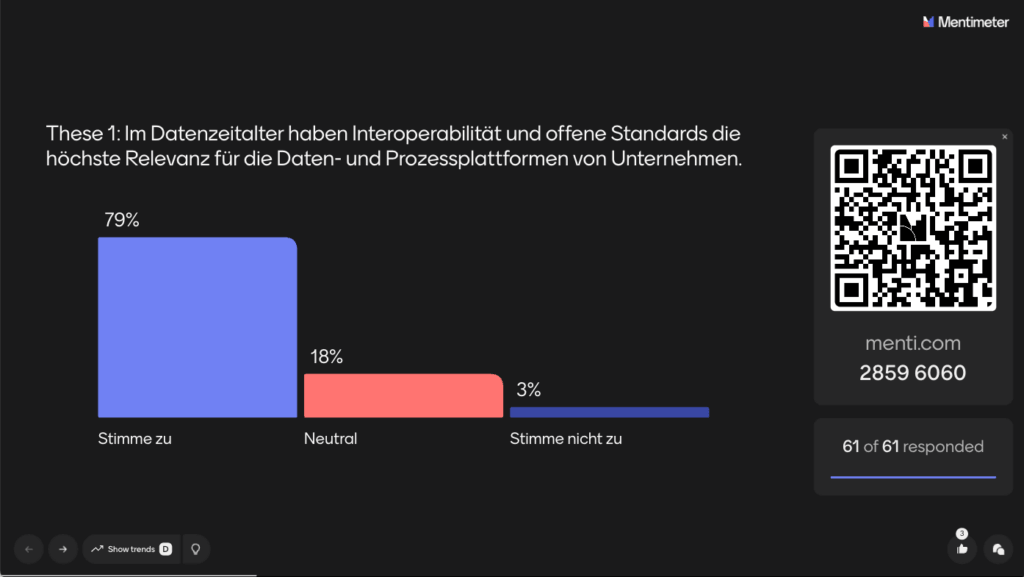
“In the age of data, interoperability and open standards are of the utmost importance for companies’ data and process platforms.”
79 percent agreed, while only 3 percent disagreed.
That’s not surprising. Hardly any company today operates exclusively within an SAP environment. Modern process landscapes integrate ERP systems with CRM, PLM, MES, IoT, and numerous cloud applications. The easier it is to orchestrate data and processes across system boundaries, the faster innovation happens.
The message from the participants is clear: Open architectures are no longer just a “nice-to-have,” but a strategic prerequisite for future viability.
Insight 2: AI is not a cloud project
The second thesis also met with broad approval:
“To use AI, you don’t have to switch to S/4HANA or move to the cloud. On-premises customers can also automate and optimize their business processes with the help of AI.”
69 percent agreed, only 2 percent disagreed with the statement, and as many as 29 percent did not want to take a position on this.
What is particularly noteworthy here is that, apparently, more and more companies no longer view AI exclusively as part of a cloud transformation. Instead, there is a growing recognition that existing on-premises environments can also be intelligently expanded. They are clearly no longer a hindrance to innovative ambitions. AI is thus increasingly becoming a capability that can be deployed regardless of the operating model—provided that data, processes, and integrations are properly prepared.
Insight 3: Strategic continuity is being critically examined
The discussion surrounding the third thesis was particularly interesting:
“You can’t really count on SAP decisions to stand the test of time: Technologies and solutions that were once considered strategic (e.g., SAP Build Apps) are being discontinued. SAP customers often end up footing the bill for migration to the next generation.”
55 percent agreed with this statement, while 45 percent disagreed.
The results do not reveal a consensus—but they do indicate a noticeable sense of uncertainty.
Many companies invest in platforms, development tools, and architectures over the course of several years. If strategic technologies are later discontinued or realigned, this results in additional migration efforts and investments.
That is precisely why architectures that are stable in the long term and as open as possible are becoming increasingly important.
Insight 4: Vendor lock-in is a concern for many companies
The fourth thesis also struck a chord:
“SAP uses its market power to create artificial barriers for customers, for example, when they want to access SAP data. Dependence on SAP is already very high, and wherever possible, we should avoid further vendor lock-in.”
83 percent agreed, and 17 percent remained neutral on this issue .
The discussion is not directed against SAP as a strategic partner. Rather, it centers on the fundamental question of how companies can preserve their freedom of action in the future. Many CIOs today face the challenge of implementing innovations quickly without unnecessarily locking themselves into a specific technology. Open standards, flexible integration platforms, and clean-core strategies are therefore becoming increasingly important.
The real takeaway: Companies are seeking greater autonomy
When you look at all four polls together, a clear trend emerges. The discussion has long since moved beyond just cloud versus on-premises or SAP versus non-SAP. Instead, the focus is on the question:
How can innovation, artificial intelligence, and process modernization be structured in a way that allows companies to remain flexible in the long term?
The participants at our Customer Summit gave a clear answer to that question:
- Open standards are becoming increasingly important.
- AI should be usable regardless of the operating model.
- Long-term investment security is becoming increasingly important.
- Additional dependencies should be avoided whenever possible.
This discussion will continue to be a topic for many companies in the years to come. After all, digitization today no longer means simply introducing new technologies—but, above all, ensuring the company’s ability to act effectively in the long term.
Conclusion
The live poll at Simplifier MAKERS X-CHANGE (MX26) showed that SAP users think strategically. They are looking for ways to implement innovations more quickly, make effective use of artificial intelligence, and at the same time maintain their technological independence. This is precisely where one of the most important tasks of modern IT architectures likely lies: combining stability and openness—without forcing companies to choose between innovation and control.
Want to know more?
We’d be happy to share more highlights and valuable insights from the MX26 customer presentations with you—just let us know if you’re interested!