

Part 1:
How Business AI Is Really Changing Manufacturing
Today, many companies are no longer asking themselves whether they should use artificial intelligence, but rather how they can use AI in a way that delivers real business value—not as a lab experiment, not as a front-end chatbot, but as a productive part of their day-to-day business processes. This is exactly where Business AI comes in. And this is exactly where it becomes clear why Simplifier is more than just a low-code platform.
What Sets Business AI Apart from Other AI Approaches
Simplifier is the operating system for AI solutions. Companies define so-called business agents in the Agent Builder, connect them to the existing integration layer, select the appropriate language model for each use case, and run everything in a centralized, governance-enabled runtime. The key point: Business Agents are natively embedded in Simplifier. They are not integrated as third-party components, but are created, integrated, and operated as part of the platform. This means AI is not limited to tools or chat windows, but is embedded directly into business processes—where decisions are prepared, data is processed, and tasks are automated.
This is what makes Business AI with Simplifier enterprise-ready—with control, transparency, and measurable benefits.
Production: Where Business AI Has the Greatest Impact
Manufacturing is one of the areas where the gap between potential and reality is particularly wide. Machine downtime, manual quality checks, rigid production schedules, and unnecessary energy costs—all of these things cost money every day. And all of these issues can be specifically addressed with Business AI.
Four use cases illustrate what is possible in practice:
- Predictive Maintenance Agent – Predict downtime before it happens
- The problem: Machine breakdowns usually come as a surprise. They cause costly production stoppages, rush orders, and overtime. Preventive maintenance at fixed intervals is better, but not ideal, because it ignores the machine’s actual condition.
- The Business AI Solution: The agent continuously reads sensor data—vibration, temperature, power consumption—and identifies patterns that indicate impending defects. As soon as a critical threshold is exceeded, it automatically creates a maintenance order in SAP PM.
- Here ’s a concrete example from real-world practice: On a CNC milling machine, the vibration levels of a spindle bearing rise slightly but steadily over a two-week period. The agent recognizes the pattern as a precursor to bearing failure and triggers a maintenance order. The spindle is replaced on the next scheduled downtime day. There is no unplanned production stoppage.
- The economic benefit: Maintenance exactly when it’s needed—no downtime, no wasted materials.
- Target: −45% unplanned machine downtime
- Quality Control Agent – Zero-Defect Principle on the Production Line
- The problem: Manual visual inspections of components are slow, error-prone, and expensive. Subtle defects are not always detected before defective parts are processed further or shipped.
- The Business AI Solution: High-resolution cameras automatically capture every component. The agent analyzes the images in real time, detects defects, and immediately rejects defective parts. Detected defect patterns are reported back to production control so that the cause is not only corrected but permanently eliminated.
- Here’s a concrete example: On a welding line, the agent detects a slightly misaligned weld. The defective part is removed, and the cause—a minimally misaligned robot position—is automatically reported and corrected.
- The economic benefit: the zero-defect principle in production—scrap is reduced, and customer satisfaction increases.
- Target: −60% scrap rate
- Production Planning Agent — Respond Flexibly Instead of Manually Rescheduling
- The problem: Production schedules are disrupted daily by machine breakdowns, material shortages, or rush orders. Manual rescheduling is complex and takes too long for the dynamic nature of day-to-day manufacturing.
- The Business AI Solution: The agent monitors production progress in real time and automatically reschedules immediately in the event of disruptions. It takes into account machine availability, setup times, material inventory, and order priorities—and automatically notifies the affected departments.
- Here’s a concrete example: A laser cutting machine is down for four hours. The agent analyzes all open orders, identifies which ones can be rescheduled, adjusts priorities, and notifies logistics and shipping—all within minutes rather than hours.
- The economic benefit: The production schedule remains optimal even in the event of disruptions. Delivery dates are met.
- Target: +15% capacity utilization
- Energy Optimization Agent – Reduce Costs Without Losing Production
- The problem: Energy is a major cost factor in production—and is often poorly optimized. Machines run at full capacity even though more efficient configurations would be possible.
- The Business AI Solution: The agent learns the energy behavior of all systems and continuously adjusts operating parameters to minimize consumption. It also takes current electricity prices into account—and automatically shifts loads to cheaper time slots.
- Here’s a concrete example: A stamping plant consumes particularly expensive electricity during peak hours. The agent automatically reschedules non-time-critical production steps to off-peak hours and reduces power consumption by optimizing machine parameters.
- The economic benefits: Lower energy costs and a reduced carbon footprint—without any loss of production.
- Target: −20% in energy costs
What all four use cases have in common
Each of these agents shares the same basic structure: It connects existing systems—SAP, MES, IoT sensors—with AI intelligence, operates within defined rules, and provides humans with a basis for decision-making exactly when it matters most. This isn’t AI that replaces processes. It’s AI that makes processes more cost-effective—with transparent results, centralized governance, and measurable ROI.
Conclusion: Business AI starts with the right foundation
The good news for medium-sized manufacturing companies: Business AI isn’t just a pipe dream. The use cases exist, the added value is quantifiable, and implementation doesn’t have to be a major undertaking. With Simplifier as an Agentic AI automation platform, business agents can be quickly defined, seamlessly integrated into existing systems, and securely operated—on-premises or in the cloud, without vendor lock-in, and made in Germany.
Harness the potential of AI across a wide range of departments
Over the next few weeks, we’ll be presenting AI-powered use cases for various business processes. If you’d like to get a glimpse of the potential of business AI for your department’s processes right now:
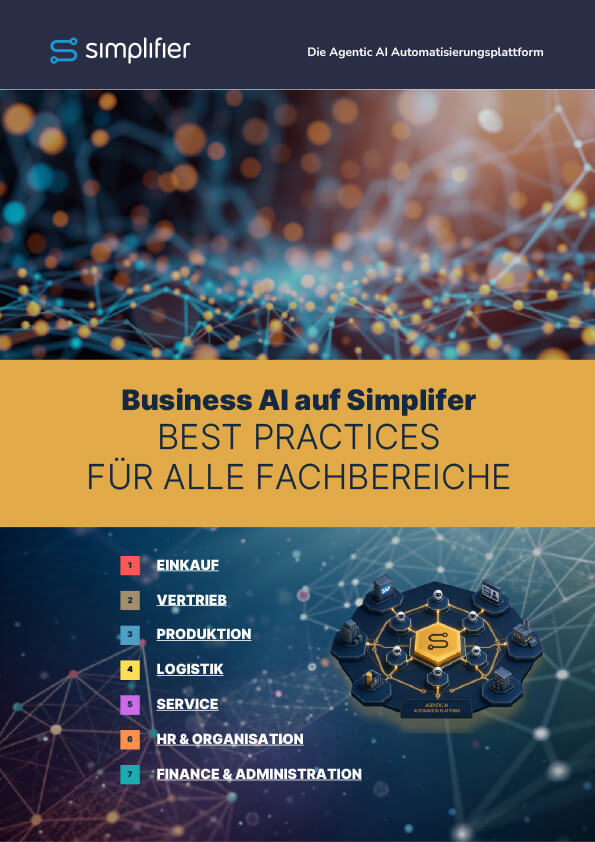
Download the complete BEST PRACTICES edition for free here!
- Use cases from manufacturing, logistics, service, HR, finance, sales, and purchasing
- Specific Examples of Business Agent Usage
- Inspiration for Your Next AI Automation Projects
And in the next installment of this series: Business AI in logistics and services —and how companies can turn reactive service processes into real competitive advantages.

