Part 2:
How Business AI Is Truly Transforming Logistics
Logistics is the nervous system of every manufacturing company. When it works, you hardly notice it. When it stalls, the entire company feels the impact immediately: delayed deliveries, overloaded loading docks, order pickers searching for items, and customs paperwork that’s missing at the worst possible moment. Most of these problems have one thing in common: they don’t stem from malicious intent, but rather from too much information flowing too slowly—and from processes that simply aren’t fast enough when done manually.
That’s exactly where Business AI with Simplifier comes in. It’s not meant to replace experienced logistics teams, but rather to serve as an intelligent system that processes data in real time, prepares decisions, and handles routine tasks so that people can focus on what really requires their attention.
What Business AI Means for Logistics
Before we dive into specific use cases: Business AI is not a chatbot that answers questions. It’s about business agents—digital process actors that are integrated into existing systems, independently process data from SAP, TMS, WMS, or freight forwarding systems, and then either act automatically or provide the right person with the right basis for decision-making at the right time.
Simplifier is the operating system for these AI solutions. Business agents are defined in the Agent Builder, connected to existing systems via the existing integration layer, and run in a centralized, governance-enabled runtime. No vendor lock-in, no isolated AI experiment—just AI that delivers results right where value is created.
1. Delivery Date Agent: Realistic Deadlines Instead of Overly Optimistic Promises
The problem: Customers expect reliable delivery dates. But calculating these realistically is complex—especially since, in practice, multiple systems and departments are involved: inventory, production capacity, and shipping planning. Manual estimates are often inaccurate. The result: disappointed customers, lost trust, and frantic rework.
The Business AI Solution: When an order is received, the agent automatically calculates a realistic delivery date—by querying and consolidating data from SAP SD, current inventory levels, and shipping information in real time. It communicates the delivery date directly to the customer and proactively notifies them of any deviations.
A concrete example: A customer orders a custom machine. The agent immediately checks: Are all components available? Is there free production capacity? Can the shipping company be booked? The result: a realistic delivery date in twelve weeks, instead of the eight weeks promised previously. The customer is kept fully informed. No surprises. No loss of trust.
The business benefit: Honest commitments to deadlines protect customer relationships—and save on the costly effort involved in follow-up clarifications and goodwill gestures.
Target: +40% on-time delivery rate
2. Route Optimization Agent: Respond Flexibly Before Costs Are Incurred
The problem: Daily route planning is often done manually or according to rigid rules. But what was carefully planned in the morning may already be out of date by noon—due to traffic disruptions, road closures, or last-minute additional orders. Dispatchers spend valuable time re-planning routes and notifying customers.
The Business AI Solution: The agent dynamically plans delivery routes, taking into account load weight, vehicle capacity, time windows, and real-time traffic data. If a disruption occurs, it calculates the optimal alternative within seconds and automatically notifies all affected customers of the new arrival times.
Here’s a concrete example: A truck with four deliveries is on the road when a road is closed. The agent reacts immediately: it calculates a new route, notifies customers, and updates the route plan—all automatically, without the dispatcher having to intervene manually.
The economic benefits: Lower transportation costs, more punctual deliveries, and a lighter workload for dispatchers.
Target: −18% in transportation costs
3. Warehouse Management Agent: Zero Search Times, Automatic Replenishment
The problem: In large warehouses, hundreds of parts are put into storage, picked, and reordered every day. Without intelligent management, this leads to inefficient routes, unnecessary search times, and—in the worst case—delivery bottlenecks because a part has fallen below the minimum stock level without anyone noticing.
The Business AI Solution: The agent manages putaway and picking based on frequency and order priority and continuously monitors all minimum stock levels. If an item falls below the defined threshold, the agent automatically triggers a reorder before a shortage occurs.
Here’s a concrete example: An urgent order requires 23 different parts. The agent calculates the optimal picking route, locates each item using RFID, and detects that one component is below the minimum stock level. A reorder is triggered automatically without an employee having to check manually.
The economic benefits: Faster order picking, no time spent searching for items, and no need for manual inventory monitoring.
Target: Reduce warehouse search times by 30%
4. Customs & Export Agent: Automatic compliance, no room for error
The problem: Exporting machinery and complex equipment requires time-consuming customs clearance: classifying goods, checking export restrictions, preparing the necessary documents—all done manually and prone to errors. Anyone who makes a mistake here risks not only delays but, in the worst case, compliance violations with significant legal consequences.
The Business AI Solution: The agent automatically classifies goods, checks embargo lists and export licenses in real time, and generates all required customs documents directly from SAP GTS. In the case of critical goods, it automatically escalates the issue before the goods are prepared for shipment.
Here’s a concrete example: A facility containing dual-use goods is to be exported. The agent recognizes that an export license is required, immediately notifies the responsible administrator, and initiates the license application—at a time when all options are still open.
The business benefits: zero compliance violations, faster processing, a lighter workload for the export department, and, above all, no unpleasant surprises right before loading.
Target: 80% reduction in manual effort in customs clearance
What All Four Use Cases Have in Common
Logistics is not a field where you can simply wait for a single solution. The problems are diverse, the systems are complex, and the requirements vary depending on the industry and company size. That’s exactly why Simplifier’s approach is crucial: Business Agents aren’t rolled out as a one-size-fits-all solution, but are defined and operated based on the existing system landscape—flexibly, seamlessly, and scalably.
What all these logistics agents have in common is that they integrate data from different systems in real time, operate within clear rules, and provide people with a basis for decision-making precisely when it really matters. AI is not a substitute for experience, but rather an enhancer.
Conclusion: We need logistics that thinks for itself
The logistics of the future aren’t faster because of more staff or more warehouse space. They’re faster because information is no longer lost, decisions are no longer based on experience alone, and routine tasks are handled automatically before they become problems.
Business AI with Simplifier makes this possible today—not as a vision for the future, but as a concrete, actionable solution for midsize companies with SAP environments.
Read Part 1: Business AI in Manufacturing
Harness the potential of AI across a wide range of departments
Over the next few weeks, we’ll be presenting AI-powered use cases for various business processes. If you’d like to get a glimpse of the potential of business AI for your department’s processes right now:
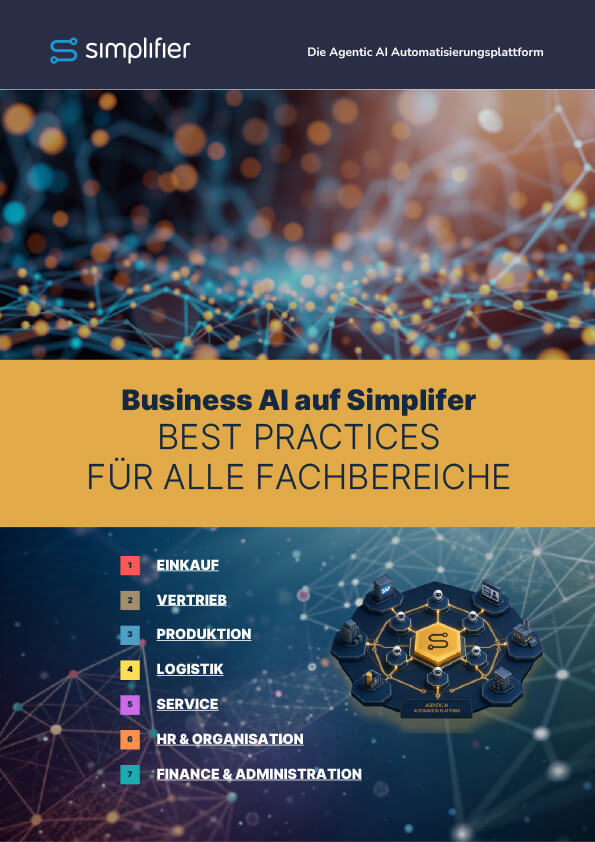
Download the complete BEST PRACTICES edition for free here!
- Use cases from manufacturing, logistics, service, HR, finance, sales, and purchasing
- Specific Examples of Business Agent Usage
- Inspiration for Your Next AI Automation Projects
And in the next installment of this series: Business AI in logistics and services —and how companies can turn reactive service processes into real competitive advantages.