Europe still too often discusses digital sovereignty as a question of the model: Where was it developed, trained, and operated? These questions remain important. For companies, however, they do not go far enough. As soon as AI agents access data, operate tools, delegate tasks, and prepare decisions, the decisive control shifts to another layer: orchestration.
The strategic thesis of this article is: A company does not need to own every model it uses to remain capable of acting. However, it must control the rules by which models, agents, knowledge, and people interact. Seamless AI orchestration makes models interchangeable, access traceable, human authority binding, and regulatory requirements technically enforceable. It is therefore not just another piece of middleware, but the future operating system of the AI-native organization.
The debate over the model obscures the actual dependency
The capabilities of foundation models are growing, but their deployment remains concentrated among a few providers. The report published by the European AI Office in July 2026 describes Europe’s position in sober terms: The EU has strong research, talent, industrial expertise, and regulatory influence, while development and capital for frontier AI remain concentrated primarily outside Europe. The expert group therefore defines sovereignty not as complete self-sufficiency, but as the ability to access frontier models, choose among them, control them, and derive benefit from them.
This shift in perspective is crucial. A European company can operate a model in a European data center and still lack autonomy if its agent logic is tied to proprietary systems, permissions remain unclear, or knowledge flows unchecked into external contexts. Conversely, it can use models from various sources and maintain a high degree of freedom of action if it designs the control points of the overall system itself.
Sovereignty is therefore not a mark of origin. It is a property of the system.
AI Applications Are Becoming Action Systems
The first generation of generative AI answered questions. Agent-based systems take action: they read files, modify datasets, task specialized agents, trigger workflows, and escalate decisions to humans. This fundamentally changes the risk profile.
A single model can be evaluated for safety, quality, or bias. In an agent-based system, however, the result emerges from a chain of interactions:
- A target is interpreted.
- Context and organizational knowledge are selected.
- A model is routed for a subtask.
- Tools and data sources are accessed.
- Additional agents will be integrated.
- A person confirms, corrects, or takes responsibility.
- The system learns from past performance and results.
The quality of this chain does not depend primarily on the strongest model. It depends on whether responsibilities, boundaries, and feedback loops are clearly orchestrated. The article “Enterprise AI Needs More Than Just the Right LLM” also illustrates how this shift puts the traditional model selection into perspective.
Open protocols are accelerating this transformation. The Model Context Protocol standardizes the connection between AI applications, tools, and data. A2A addresses collaboration between agents from different vendors and frameworks. This is a significant step forward for interoperability. However, interoperability alone does not create sovereignty. An open protocol can enable connections; it does not determine who is allowed access, which data leaves the context, when an agent must stop, or which person is responsible for a decision.
This is exactly where the strategic role of orchestration begins.
The Sovereign Orchestration Stack
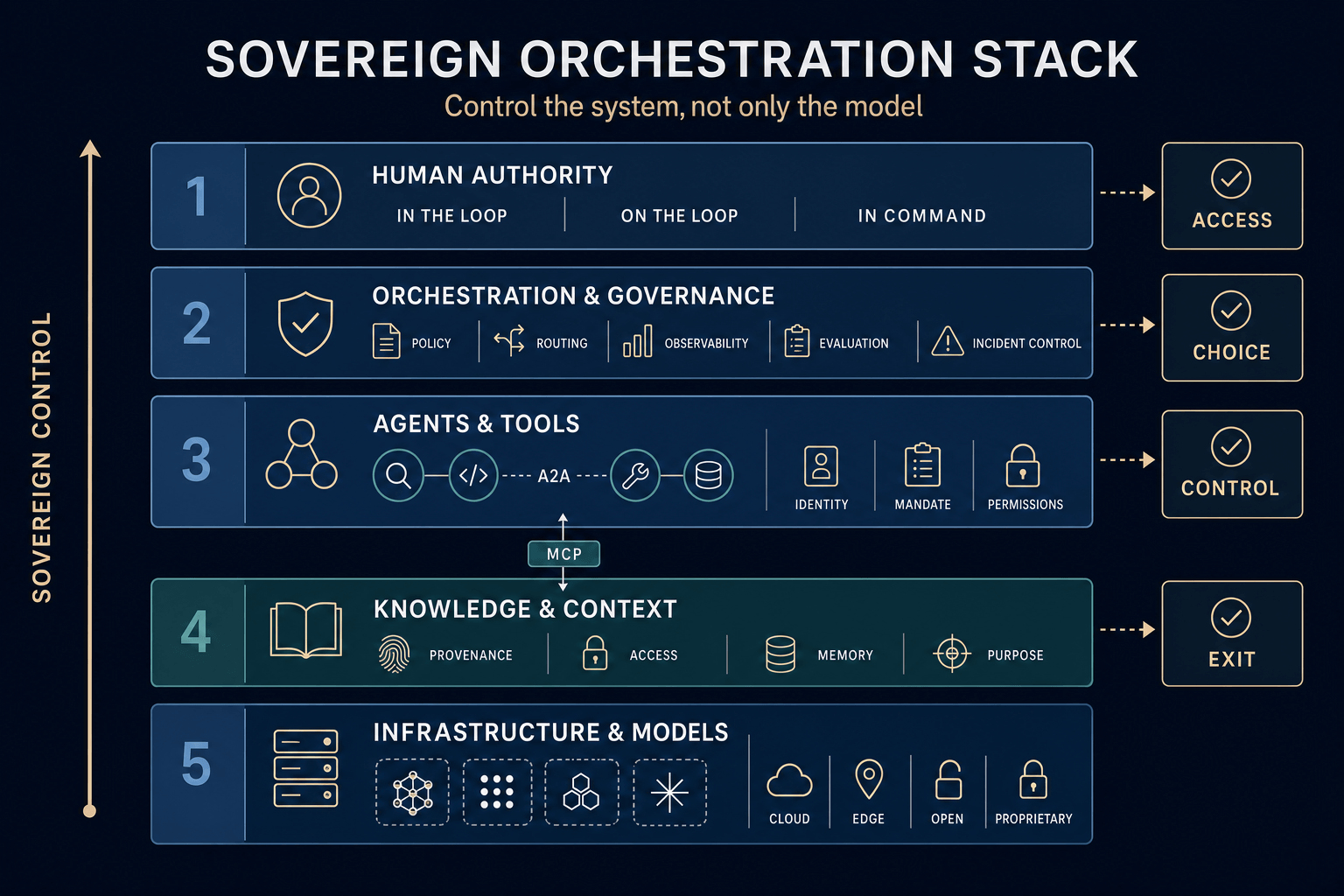
Effective AI orchestration can be understood as five control layers that build upon one another.
1. Infrastructure and Models: Freedom of Choice Instead of Pseudo-Self-Sufficiency
The bottom layer comprises compute, cloud, edge, and models. Europe’s investments in AI factories, planned gigafactories, and data capacities strengthen this foundation. For companies, however, the goal is not to run every workload on a single European model. What matters most is a robust exit strategy:
- Models can be selected based on task, risk, cost, and data class.
- Critical workloads can be run locally, in a sovereign cloud, or at the edge.
- Interfaces and evaluations prevent the organization from remaining tied to a single model of behavior.
Multi-model capability is not a selling point here, but rather a resilience architecture. The analysis “When AI Costs Skyrocket” explains why rising costs and vendor lock-in also call for an exit strategy.
2. Knowledge and Context: Organizational Memory Under Our Own Control
Models are interchangeable. A company’s institutional knowledge is not. Policies, customer experience, process logic, technical documentation, and decision histories constitute the true source of differentiation.
A robust knowledge layer therefore governs data provenance, access rights, timeliness, retention, and purpose limitation. It separates permanent organizational knowledge from transient agent context. It documents which source contributed to which conclusion. And it prevents an external model provider from gradually becoming the owner of the organization’s memory.
3. Agents and Tools: Limit Capabilities, Not Just Verify Identities
In traditional IT systems, users are assigned roles. In agent-based systems, agents also need verifiable identities, time-limited mandates, and the minimum necessary permissions. A research agent may collect information but may not automatically approve a supplier contract. A procurement agent may compare bids but may only act within defined thresholds.
The relevant unit is not just the agent, but its specific capability in the given context. This requires a machine-readable policy model: Who is allowed to access which data using which tool, for what purpose, and what action may they trigger?
4. Orchestration and Governance: Rules Become Executable Architecture
This is where goals are broken down, models are routed, agents are coordinated, policies are enforced, and exceptions are handled. This layer connects enterprise architecture with governance.
She should be proficient in at least five functions:
- Policy Enforcement: Rules take effect before an action is taken, not just during the audit.
- Observability: Decisions, tool calls, context sources, and data transfers remain traceable.
- Evaluation: Quality, risk, and costs are continuously measured throughout the entire chain.
- Fallback and Exit: Models or services can be replaced without having to rebuild the process.
- Incident Control: Agents can be stopped, isolated, and reset to a safe state.
The EU AI Act reinforces this approach. Key transparency requirements have been in effect since August 2, 2026, and oversight has become operational. For high-risk systems, the focus is on logging, documentation, human oversight, robustness, and risk management, among other things. Companies that treat these requirements merely as after-the-fact compliance documentation accumulate technical debt. In a well-designed orchestration architecture, these become runtime properties.
5. Human Authority: Responsibility Cannot Be Automated
“Human-in-the-loop” is often understood as a final approval step at the end of a workflow. That is not enough. People must set goals, assess uncertainty, resolve conflicts between criteria, and define the limits of automation.
Not every action requires the same level of human involvement. A sustainable operating model distinguishes between:
- Human-in-the-loop for irreversible decisions or those involving fundamental rights,
- Human-on-the-Loop for monitored, reversible processes,
- Human-in-Command for objectives, mandates, escalation rules, and system boundaries.
The highest level of sovereignty is not maximum autonomy. It is the ability to consciously regulate one’s autonomy.
From an AI platform to an organizational control system
Many companies start with a central AI gateway or a model platform. That makes sense, but it isn’t enough. A gateway controls technical access. Effective orchestration controls organizational impact.
To achieve this, CIOs, CTOs, and governance leaders must integrate three previously separate disciplines: enterprise architecture, AI governance, and organizational design. The key question is no longer, “Which model should we use?” It is now, “Under what conditions is our human-AI system permitted to make which decisions and take which actions?”
Four steps create a solid foundation:
- Map the checkpoints. Make data access, models, tools, delegations, decisions, and human handoffs visible for every agent-based process.
- Define sovereignty classes. Classify workloads based on criticality, data residency, reversibility, and societal impact.
- Implement policies as code. Technically enforce and version control access, routing, authorization, and logging rules.
- Test the exit regularly. Don’t just test disaster recovery—actually swap out models, vector stores, agent frameworks, and cloud services.
A system is truly self-sufficient only when the transition is not only contractually possible but has also been practiced in an operational setting.
Europe’s strategic opportunity lies between regulation and infrastructure
Europe is investing in computing capacity, data centers, expertise, and open models. At the same time, the AI Act establishes a framework for trustworthy systems. However, there is a strategic gap between these two levels: the architecture that translates European principles into the day-to-day operation of agent-based systems.
This is precisely where a competitive advantage can arise. European companies do not need to imitate the global race for every major model. They can take the lead in developing controllable, interoperable, and human-centered AI systems. This requires open interfaces, portable policies, verifiable agent identities, and governance that not only generates documents but also steers behavior.
The winners of the next phase will therefore not necessarily be the organizations that have access to the most powerful model. Models are becoming more widespread, prices are falling, and performance differences are narrowing depending on the task. What remains difficult to replicate is the ability to reliably coordinate people, knowledge, and AI systems.
Conclusion
Digital sovereignty does not mean building every component yourself. It means identifying critical dependencies, maintaining choices, and not outsourcing responsibility to technology providers.
For an AI-native organization, orchestration becomes the strategic control layer. This is where decisions are made regarding which model has access to which knowledge, which agent is authorized to perform which action, when a human must intervene, and whether a system remains capable of switching modes and stopping in an emergency.
Europe’s task, therefore, is not merely to develop more AI. Europe must create better conditions for trustworthy collaboration between humans and AI. Sovereignty arises when this collaboration is consciously designed, technically implemented, and institutionally accountable.
The strategic question for leadership teams is: Are we just controlling our models, or are we already controlling the system that trades using them?