Rapid application development: The agile revolution with the Simplifier low-code platform

How modern low-code technology is redefining the principles of rapid application development and accelerating IT modernization, especially in the SAP ecosystem.

In a world characterized by digital transformation and constant change, companies are faced with the challenge of developing their software solutions faster, more flexibly and more cost-efficiently than ever before. Traditional, rigid development models such as the waterfall model are reaching their limits here. They are often too slow, too expensive and difficult to react to changing requirements. In response to this inefficiency, a more agile approach was developed decades ago: the Rapid Application Development (RAD).

The aim of RAD is to radically accelerate the software development process while maximizing quality and user acceptance. This is achieved through iterative cycles, the construction of prototypes and close collaboration between developers and users. Today, these principles are experiencing a renaissance and are being taken to a new level by modern technologies such as low-code platforms. The Simplifier platform is a prime example of how the RAD philosophy is being implemented in the 21st century to support companies, particularly in the complex SAP environment, with digitalization and IT modernization.
The basics of Rapid Application Development (RAD)

To understand how platforms like Simplifier are revolutionizing application development, a look at the origins and core ideas of RAD is essential. The approach is more than just a method – it is a mindset that shifts the focus from rigid planning to flexible implementation.

History and development of RAD

The roots of rapid application development go back to the 1970s. Pioneers such as Brian Gallagher, Alex Balchin, Barry Boehm and Scott Shultz developed the first approaches to speed up the time-consuming software development process that prevailed at the time and make it more flexible. Their aim was to counter the lengthy cycles of the waterfall model, in which one phase had to be completed after the other, with a more dynamic model.

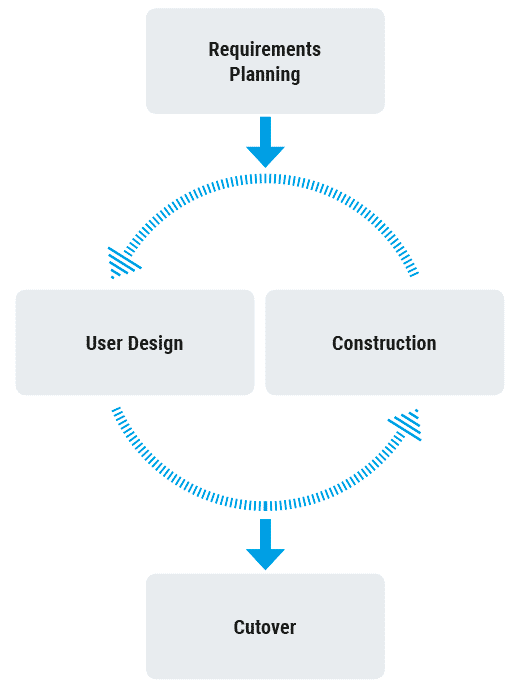
However, rapid application development only really became famous a few years later. In the early 1990s, the British information technology consultant and author James Martin the method. His approach was largely based on iterative development and the consistent construction of prototypes. Instead of working for months on a theoretical requirements document, developers were to create an initial, functional version of the software (a prototype) as quickly as possible. This prototype served as a basis for discussion with the end users, whose feedback was incorporated directly into the next iteration. This cycle of building, testing and adapting is repeated until the final application fully meets the needs of the users.

The core principles of the RAD model

RAD’s success is based on several fundamental principles that interlock to ensure speed and quality:

Iterative development & prototyping

The heart of RAD. Instead of a single, long development cycle, the software is developed in small, manageable steps. Each iteration delivers an improved prototype that enables immediate feedback. Errors and misunderstandings are identified and corrected at an early stage, drastically reducing the risk of the overall project failing.

Active involvement of users

In the RAD model, end users are not passive clients, but active members of the development team. Their continuous involvement ensures that the software developed does not fail to meet the actual needs of the business. Workshops and regular demos replace thick specification documents.

Reusability of components

RAD promotes the creation of a library of reusable modules (components). Instead of programming every function from scratch, developers can fall back on existing modules. This not only speeds up development, but also ensures greater consistency and stability of the applications.

Timeboxing

Each iteration is carried out within a fixed time frame (“timebox”) of typically 60 to 90 days. This approach forces the team to focus on the most important functions and prevents projects from getting out of hand (“scope creep”). Features that do not fit into a timebox are prioritized for a later iteration.

Simplifier: The modern interpretation of RAD in the enterprise environment

The rapid application development approach is still widely used in the development environment today. Modern low-code platforms are the logical further development of the RAD principles. They provide technologies that make it possible to implement James Martin’s ideas with today’s technical possibilities. The Simplifier low-code platform is leading the way, especially when it comes to IT modernization in the SAP ecosystem.

Low-Code Power for the SAP Ecosystem and Beyond.” – Simplifier’s slogan summarizes its mission: To enable companies to modernize their IT landscape in an agile way and develop high-performance applications.

How Simplifier redefines the RAD principles

Simplifier translates the classic RAD principles into concrete technological functions and methods that transform application development:

  • RAD’s Prototyping → Simplifier’s visual editor: The core of Simplifier is a visual drag-and-drop editor. Instead of writing code, developers and even tech-savvy business users (citizen developers) can assemble user interfaces and business logic through configuration. A functional prototype that used to take weeks can now be created in hours or days. This is rapid prototyping in its purest form.
  • RAD’s User Involvement → Citizen Development & Fusion Teams: Simplifier actively promotes collaboration between IT and business departments through concepts such as Citizen Development and Fusion Teams. Business users who know their processes best are empowered to create simple applications themselves or to work on more complex solutions in mixed teams (Fusion Teams) together with IT professionals. This is the ultimate form of user involvement.
  • RAD’s Reusability → Reusable building blocks & connectors: The platform is based on the principle of reusable building blocks. Once created, UI components, business logic or integrations (e.g. to an SAP system) can be saved as “Simplifier building blocks” and reused in any number of other applications. This ensures enormous efficiency and consistency in the digitalization of business processes.
  • RAD’s Timeboxing → Agile development with low-code: The speed achieved through low-code fits perfectly with the timeboxing approach. Development teams can deliver fully functional application increments in short sprints (e.g. two weeks). The rapid iteration makes it possible to react flexibly to market changes or new business requirements.

IT modernization in the SAP ecosystem

Simplifier is the leading low-code platform for IT modernization in the SAP ecosystem. It enables companies to implement individual Fiori applications develop, automate processes and integrate SAP seamlessly with other systems – from the business level (top floor) to the production level (store floor). Thanks to the RAD approach and rapid prototyping, Simplifier makes it possible to effectively develop a comprehensive and performance-oriented application in less time.

Rapid generation of productive code
The rapid application development approach enables the rapid creation of functioning code and prototypes. The processes are fluid and merge into one another, which not only creates greater transparency but also results in a faster development time.

Measurable progress
With frequent iterations, components and prototypes that are stretched out, the progress of the overall project, but also of smaller segments, can be easily measured and evaluated. This allows schedules and budgets to be adhered to.

Higher quality
Through the constant interaction between users and the developing prototype, the rapid application development approach can ensure higher quality. The software can therefore be more user-friendly.

Higher quality
Through the constant interaction between users and the developing prototype, the rapid application development approach can ensure higher quality. The software can therefore be more user-friendly.

Early system integration
While most software projects traditionally have to wait until the end of the lifecycle to begin integrations with other systems or services, a Rapid Application Development application is integrated almost immediately. Through early integrations within a prototype, the Rapid Application Development system quickly detects any errors or complications within the integrations and forces immediate solutions.

Simple customizability
During development, software is a fairly customizable form. Since code can be changed at any time, leading to changes in the system or even new components being generated, it is beneficial for the development team to take advantage of this flexibility early and often by iterating and prototyping potential concepts or ideas throughout development.

Mastering digitalization – with Simplifier

The challenges of digitalization are enormous, especially in the manufacturing industry. Companies are struggling with complex IT landscapes, the need for real-time data and the difficult integration of legacy systems. This is where the strength of the RAD approach in combination with the Simplifier platform comes into play. Simplifier addresses the core challenges of production digitalization: store floor integration, AI integration and seamless SAP connection.

Store floor integration: RAD directly in production

The digitalization of production (store floor) requires fast and flexible solutions. With Simplifier, applications for mobile data collection, for visualizing key performance indicators (KPIs) or for accessing digital work instructions can be developed and rolled out in the shortest possible time. This improves transparency, efficiency and user acceptance directly at the point of action.

  • Real-time data integration: Connection to production systems (MES), IoT sensors and machines to provide status information in real time.
  • Mobile data capture: Development of mobile apps that replace paper-based processes and reduce the susceptibility to errors.
  • KPI visualization: Attractive dashboards that visualize key performance indicators such as output quantity or productivity and make deviations immediately visible.

Seamless and secure SAP connection

For many companies, SAP is the heart of their IT. Every extension or change entails risks. Simplifier is characterized by seamless integration into SAP environments without modifying the SAP core. This “Clean core” approach is crucial for the stability and maintainability of the SAP system.

  • Supported protocols: Simplifier uses standard protocols such as SAP RFC, OData and SOAP for secure and high-performance data transfer.
  • SAP Clean Core: Fiori apps and extensions are developed outside the SAP core. This guarantees the stability of the core system, reduces maintenance costs and optimizes the performance of the applications.
  • SAP certification: As an official SAP Silver Partner, Simplifier offers certified low-code solutions that meet the highest enterprise standards.

AI integration: the bridge to the smart factory

Artificial intelligence (AI) is a key to the next level of automation. Simplifier acts as an agile intermediary between rigid legacy systems such as SAP and dynamic AI applications. With the platform, AI-supported applications that use machine learning or computer vision, for example, can be implemented up to 90 % faster be developed.

Simplifier as a low-code platform for integrating systems such as SAP, PLC and SCADA with modern AI applications.

Use cases with high ROI: RAD in practice

The true strength of a development approach is demonstrated in practice. The projects implemented with Simplifier impressively demonstrate how the RAD approach leads to significant cost savings, increased efficiency and a rapid return on investment (ROI).

Three examples from production digitization

  • Digital fault management
    + € 220,000 Total ROI per year through faster response, higher delivery reliability and reduced maintenance costs.
  • Digital work instruction
    97% error reduction through guided, digital processes and a monthly process cost saving of €10,000.
  • Loading control & shipping
    + € 93,000 Annual savings through a fully digitalized and automated shipping process.

Use case 1: Digital fault management

A mobile app developed with Simplifier is revolutionizing fault management in production. Employees can quickly record faults directly on site, document them with photos and forward them to the responsible team. This shortens response times, increases transparency and enables predictive maintenance.

  • ROI drivers: 15% higher delivery reliability, reduced disruption times and costs, savings on special transports.
  • Result: Savings and additional sales totaling €220,000 per year.

Use Case 2: Digital work instructions

An app for digital work instructions guides production employees step by step through complex assembly processes. Guided processing drastically minimizes the error rate and optimizes the flow of information. A management dashboard enables real-time monitoring of progress and eliminates the need for time-consuming reporting meetings.

  • ROI drivers: Avoidance of incorrect entries, optimized information flow, elimination of meetings.
  • Result: An error reduction of 97%, €10,000 savings in monthly process costs and 5 days of time saved per month.

Use Case 3: Loading control & shipping

This app digitizes the entire loading and shipping process. The use of dynamically generated QR codes and seamless integration with the SAP system eliminates manual input errors and automates the entire process. Employees manage and complete processes directly in the app.

  • ROI driver: Automation of manual steps, error-free processing, digital process control.
  • Result: An error elimination of 97 % in the loading processes and annual savings of 93,000 €.

Conclusion: The future of application development is agile and low-code

Rapid application development has permanently changed software development by focusing on speed, flexibility and user centricity. Today, in the age of digital transformation, these principles are more relevant than ever. Modern low-code platforms such as Simplifier are the technological embodiment of the RAD philosophy.

We enable companies to close the gap between business requirements and IT capacities. Especially in the complex SAP environment, Simplifier unfolds its full potential by enabling agile IT modernization without jeopardizing the stability of core systems. By promoting citizen development, providing reusable components and quickly turning prototypes into productive applications, the vision of rapid application development becomes a reality.

Your next step towards IT modernization

Are you ready to accelerate your application development and future-proof your IT landscape? Bring IT and business together and use the Simplifier low-code platform to develop customized SAP Fiori applications, automate processes and promote innovation in your company.

Learn more about how Simplifier uses the RAD approach to drive your digitalization.