

Part 5:
How Business AI Is Really Changing Sales
Sales teams in the capital goods industry are familiar with this dilemma: A customer requests a quote, the sales representative spends two days coordinating between configuration, pricing, and engineering—and by the time the quote is finally sent out, the competition has long since responded. At the same time, dozens of leads come in every day, and no one knows which ones actually have potential. And what about systematically nurturing existing customers? That falls by the wayside in the hectic day-to-day business.
This isn’t a resource problem—it’s a structural problem. And this is exactly where Business Agents on the Simplifier platform come in—not as an AI chatbot in the inbox, but as an execution layer that works directly within SAP SD, CRM, and ERP and takes care of exactly those tasks for the sales team that don’t require human expertise.
In this article, we present four specific use cases that sales teams in manufacturing companies can implement today—with measurable results.
1. Quote Agent: From receipt to a PDF ready for shipment in minutes
The problem: In the machinery and plant engineering industry, quotes are anything but standard. Customer-specific configurations, varying component prices, customized discount structures, and technical dependencies make every process unique. The result: On average, it takes 2–3 days to prepare a quote—and every delay costs opportunities.
The Business AI Solution: The Quote Agent collects customer requirements, automatically configures the appropriate product using the product configurator, accesses current price lists in SAP SD, and generates a complete PDF quote—including technical specifications and commercial terms. The sales representative reviews it, makes corrections if necessary, and sends it with a single click.
Here’s a concrete example: A customer requests a custom version of a packaging machine. In the past: Brief the technicians, finalize the configuration, prepare a quote, and obtain approvals—a two-day turnaround time. With the Quote Agent, the system configures the machine in 8 minutes, checks availability, and provides the sales representative with a quote ready to send.
Benefit: Shorter response times directly increase your chances of winning—whoever responds first has a measurable advantage.
Target: −70% quote turnaround time
2. Lead Scoring Agent: Focus on the inquiries that really matter
The problem: Sales teams receive numerous inquiries every day—via email, website forms, and trade show follow-ups. Employees often rely on gut instinct to decide which of these will actually lead to a sale. The result: Good leads are addressed too late, while weak ones are pursued for too long.
The Business AI Solution: The Lead Scoring Agent analyzes every incoming inquiry based on defined criteria: company size, industry, purchase history, website behavior, and similarity to previous successful deals. It assigns a score and provides a clear prioritization recommendation with justification—directly into the CRM, visible to the entire team.
Here’s a concrete example: Out of 50 incoming inquiries in a week, the agent identifies the 8 leads with the highest likelihood of closing a deal. An automotive supplier with an active investment project and two preliminary inquiries in the last 6 months is at the top of the list. The sales team focuses on these contacts—based on clear rationale, not on a hunch.
Benefit: The sales team works with greater focus and closes more deals with the same amount of effort.
Target: +30% conversion rate
3. After-Sales Representative: Systematically Develop Existing Customers
The problem: Existing customers are the most valuable source of repeat business—every sales manager knows that. Nevertheless, most companies barely tap into this potential because no one has the time to systematically monitor all existing customers. Service contracts are expiring, machines are approaching their maintenance intervals, and needs for upgrades are becoming apparent—yet the sales representative often doesn’t find out until the customer has already inquired with the competition.
The Business AI Solution: The after-sales agent continuously analyzes machine uptime, wear patterns, contract expiration dates, and purchase history for all existing customers. When potential is identified, it automatically generates a contact prompt for the responsible key account manager—complete with personalized selling points and a prepared conversation opener.
Here’s a concrete example: A mill in Bavaria operates three units that will soon be due for their 10-year inspection. The agent recognizes the pattern, creates a contact suggestion for the key account manager, and proposes a retrofit offer that includes a maintenance contract—weeks before the customer takes any action. The key account manager goes into the meeting prepared, and the customer feels actively supported.
Benefits: Systematic customer relationship management without manual research—every customer is contacted at the right time.
Target: +25% in service and expansion revenue
4 Win/Loss Analysis Agent: Strategic Insights from Day-to-Day Operations
The problem: Why were some deals won? Why were others lost? Every sales manager asks this question—but rarely answers it systematically. In day-to-day operations, there isn’t enough time for structured debriefings; insights remain unspoken, and mistakes are repeated. Valuable knowledge about competitors, pricing strategies, and industry preferences is lost.
The Agentic AI Solution: The Win/Loss Analysis Agent evaluates all completed sales transactions from the CRM, customer feedback, and available competitive intelligence. It generates monthly reports with clear recommendations for action: In which industries have we lost a disproportionately high number of deals? To whom? For what reason? And what can we change?
Here’s a concrete example: The agent notices that the company in the food industry loses to a specific competitor more often than average—primarily because it lacks ATEX certification for potentially explosive atmospheres. This insight would have remained buried in hundreds of Excel spreadsheets. With the agent, it leads directly to a targeted product expansion.
Benefits: Strategic insights from day-to-day sales activities—without any extra effort or retrospective meetings.
Target: 100% transparency regarding competitive strengths and weaknesses
What these four agents have in common
None of the four agents makes decisions. The Quote Agent prepares the proposal; the sales representative approves it. The Scoring Agent prioritizes; the human decides who to call. This is no coincidence, but a principle: Business Agents on the Simplifier platform are the execution layer, not the decision-making authority. What else they have in common: They work where the sales team already works—in SAP SD, in CRM, in Outlook, and in Teams. No new portal, no parallel tool, no media discontinuity. The results are written back to the core systems, not to an AI dashboard that no one opens on a daily basis. And all four agents share the same modular framework: integration layer, approval component, logging, and LLM integration (configurable per step between Azure AI Foundry and Google Vertex). Anyone who implements the Quote Agent has already laid half the foundation for the Lead Scoring Agent.
Conclusion: AI in sales is most effective where structure meets speed
The four sales agents don’t solve new problems. They solve old problems faster, more consistently, and without capacity constraints. The quoting process has always been too slow. Lead prioritization has always been too subjective. Existing customers have always been managed too reactively. Win/loss insights have always been too implicit. The difference: Now there’s a platform that not only analyzes these processes but also executes them—directly within the systems that the sales team uses every day.
Read Part 1: Business AI in Manufacturing
Read Part 2: Business AI in Logistics
Read Part 3: Business AI in the Service Industry
Read Part 4: Business AI for Finance & Administration
Harness the potential of AI across a wide range of departments
Over the next few weeks, we’ll be presenting AI-powered use cases for various business processes. If you’d like to get a glimpse of the potential of business AI for your department’s processes right now:
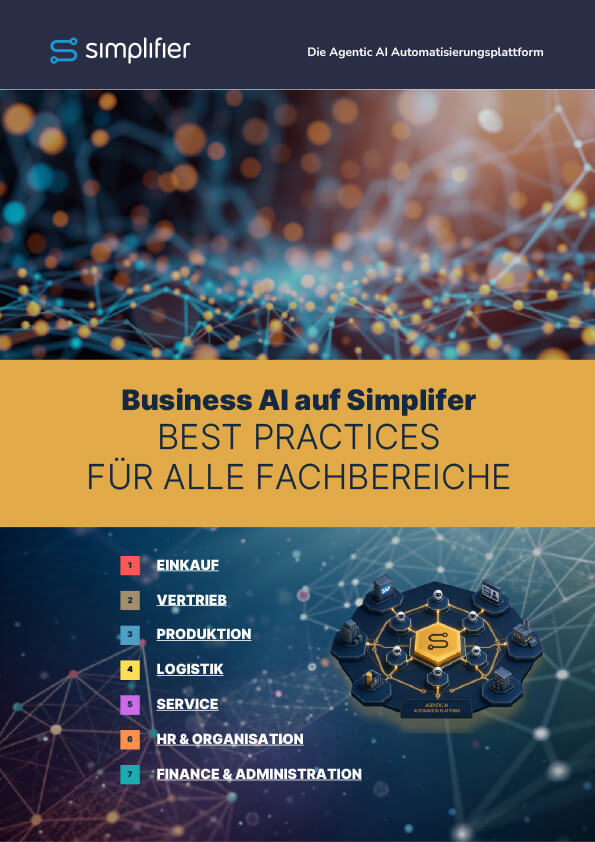
Download the complete BEST PRACTICES edition for free here!
- Use cases from manufacturing, logistics, service, HR, finance, sales, and purchasing
- Specific Examples of Business Agent Usage
- Inspiration for Your Next AI Automation Projects

